问题
一句英文写道:「Jordan beat the press.」你的 NER 把「Jordan」标为 PERSON。很好。但哪一个 Jordan?
- Michael Jordan(篮球运动员)?
- Michael B. Jordan(演员)?
- Michael I. Jordan(伯克利机器学习教授——没错,这种混淆在 ML 论文里真实存在)?
- Jordan(约旦这个国家)?
- Jordan(希伯来语名字)?
实体链接(entity linking,EL)把每个提及(mention)解析到知识库中的一个唯一条目:Wikidata、Wikipedia、DBpedia 或你自己的领域知识库。它包含两个子任务:
- 候选生成。 给定「Jordan」,知识库中哪些条目是合理的候选?
- 消歧。 结合上下文,哪个候选才是正确的?
两步都可以学习,也都有基准测试。整个 pipeline 十年来结构稳定——变化的是消歧器的质量。
概念
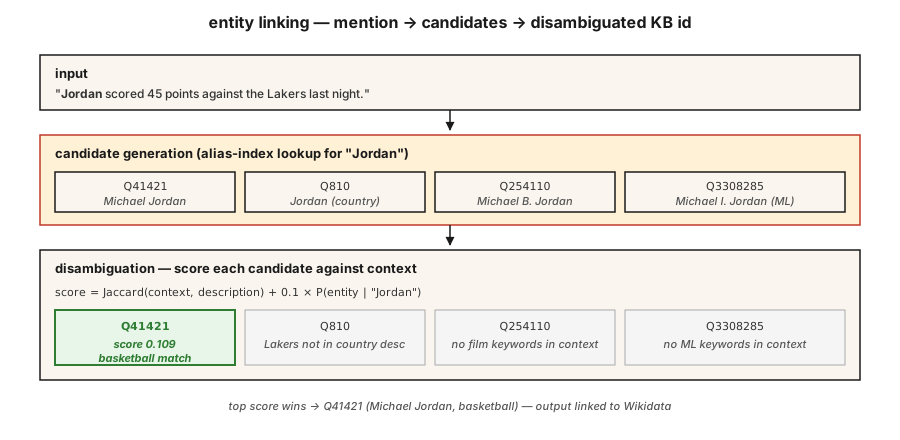
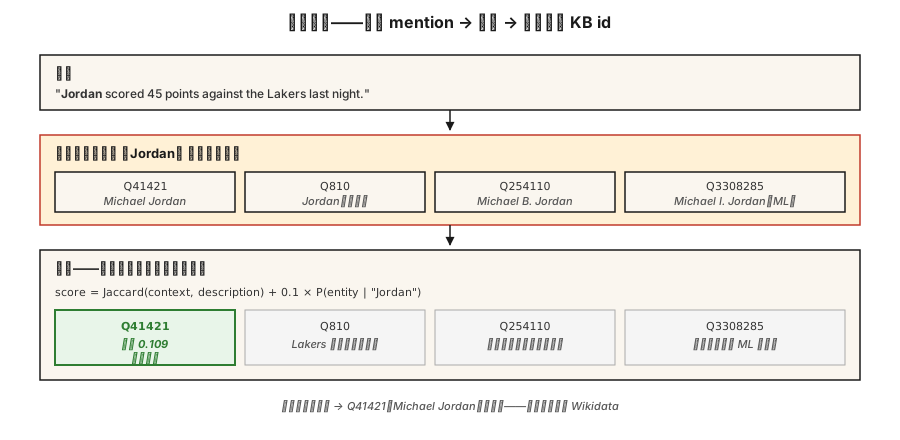
候选生成。 给定提及的表面形式(surface form,如「Jordan」),在别名索引中查找候选。Wikipedia 的别名词典覆盖了大多数命名实体:「JFK」→ John F. Kennedy、Jacqueline Kennedy、JFK 机场、电影《JFK》。典型索引对每个提及返回 10-30 个候选。
消歧:三种方法。
- 先验 + 上下文(Milne & Witten,2008)。 计算
P(entity | mention) × context-similarity(entity, text)。效果好、速度快、无需训练。 - 基于 embedding(ESS / REL / Blink)。 编码提及 + 上下文,再编码每个候选的描述,取余弦相似度最大者。这是 2020-2024 年的默认做法。
- 生成式(GENRE,2021;基于 LLM,2023 之后)。 逐 token 解码实体的规范名称,并用合法实体名构成的 trie 做约束解码,保证输出一定是合法的知识库 id。
端到端 vs. pipeline。 现代模型(ELQ、BLINK、ExtEnD、GENRE)在一次前向中完成 NER + 候选生成 + 消歧。生产中仍以 pipeline 系统为主,因为组件可以替换。
两个测量指标
- 提及召回率(候选生成阶段)。 在标注正确的提及中,正确的知识库条目出现在候选列表里的比例。这是整个 pipeline 的下限。
- 消歧准确率 / F1。 在候选正确的前提下,top-1 选对的频率。
两个指标必须同时报告。一个在 80% 候选召回上做到 99% 消歧的系统,整体 pipeline 只有 80%。
构建它
步骤 1:从 Wikipedia 重定向构建别名索引
pythonalias_to_entities = {
"jordan": ["Q41421 (Michael Jordan)", "Q810 (Jordan, country)", "Q254110 (Michael B. Jordan)"],
"paris": ["Q90 (Paris, France)", "Q663094 (Paris, Texas)", "Q55411 (Paris Hilton)"],
"apple": ["Q312 (Apple Inc.)", "Q89 (apple, fruit)"],
}Wikipedia 的别名数据约有 1800 万对(alias, entity)。可从 Wikidata dumps 下载,用倒排索引存储。
步骤 2:基于上下文的消歧
pythondef disambiguate(mention, context, alias_index, entity_desc):
candidates = alias_index.get(mention.lower(), [])
if not candidates:
return None, 0.0
context_words = set(tokenize(context))
best, best_score = None, -1
for entity_id in candidates:
desc_words = set(tokenize(entity_desc[entity_id]))
union = len(context_words | desc_words)
score = len(context_words & desc_words) / union if union else 0.0
if score > best_score:
best, best_score = entity_id, score
return best, best_score这里的 Jaccard 重叠只是玩具版本。实际应替换为 embedding 上的余弦相似度(transformer 版本见 code/main.py 的 step-2)。
步骤 3:基于 embedding(BLINK 风格)
pythonfrom sentence_transformers import SentenceTransformer
encoder = SentenceTransformer("sentence-transformers/all-MiniLM-L6-v2")
def embed_mention(text, mention_span):
start, end = mention_span
marked = f"{text[:start]} [MENTION] {text[start:end]} [/MENTION] {text[end:]}"
return encoder.encode([marked], normalize_embeddings=True)[0]
def embed_entity(entity_id, description):
return encoder.encode([f"{entity_id}: {description}"], normalize_embeddings=True)[0]建索引时,把每个知识库实体各编码一次。查询时,把提及 + 上下文编码一次,与候选池做点积,取最大值。
步骤 4:生成式实体链接(概念)
GENRE 逐字符解码实体的 Wikipedia 标题。约束解码(见第 20 课)保证只能输出合法标题,并与知识库支撑的 trie 紧密集成。现代的继承者是 REL-GEN,以及带结构化输出的 LLM 提示式实体链接。
pythonprompt = f"""Text: {text}
Mention: {mention}
List the best Wikipedia title for this mention.
Respond with JSON: {{"title": "..."}}"""配合白名单(Outlines 的 choice),这是 2026 年最容易交付的实体链接 pipeline。
步骤 5:在 AIDA-CoNLL 上评估
AIDA-CoNLL 是实体链接的标准基准:1,393 篇 Reuters 文章、3.4 万个提及、Wikipedia 实体。报告知识库内准确率(P@1)和知识库外 NIL 检测率。
常见陷阱
- NIL 处理。 有些提及不在知识库中(新出现的实体、冷门人物)。系统必须预测 NIL,而不是猜一个错误实体。这一项单独测量。
- 提及边界错误。 上游 NER 漏掉部分跨度(把「Bank of America」只标成「Bank」),实体链接的召回率就会下降。
- 热门度偏差。 训练过的系统会过度预测高频实体。ML 论文里的「Michael I. Jordan」常常被链接到篮球运动员 Jordan。
- 跨语言实体链接。 把中文文本中的提及映射到英文 Wikipedia 实体,需要多语言编码器或一步翻译。
- 知识库过期。 新公司、新事件、新人物不在去年的 Wikipedia dump 里。生产 pipeline 需要定期刷新循环。
使用它
2026 年的技术栈:
| 场景 | 选择 |
|---|---|
| 通用英文 + Wikipedia | BLINK 或 REL |
| 跨语言,知识库为 Wikipedia | mGENRE |
| 适合 LLM,每天提及量少 | 用候选列表 + 约束 JSON 提示 Claude/GPT-4 |
| 领域知识库(医疗、法律) | 带知识库感知检索的自定义 BERT,并在领域 AIDA 风格数据集上微调 |
| 极低延迟 | 仅用精确匹配先验(Milne-Witten 基线) |
| 研究 SOTA | GENRE / ExtEnD / 生成式 LLM-EL |
2026 年落地的生产模式:NER → 共指消解 → 对每个提及做实体链接 → 把同一簇折叠成一个规范实体。输出是文档中每个实体一个知识库 id,而不是每个提及一个。
交付它
保存为 outputs/skill-entity-linker.md:
markdown---
name: entity-linker
description: Design an entity linking pipeline — KB, candidate generator, disambiguator, evaluation.
version: 1.0.0
phase: 5
lesson: 25
tags: [nlp, entity-linking, knowledge-graph]
---
Given a use case (domain KB, language, volume, latency budget), output:
1. Knowledge base. Wikidata / Wikipedia / custom KB. Version date. Refresh cadence.
2. Candidate generator. Alias-index, embedding, or hybrid. Target mention recall @ K.
3. Disambiguator. Prior + context, embedding-based, generative, or LLM-prompted.
4. NIL strategy. Threshold on top score, classifier, or explicit NIL candidate.
5. Evaluation. Mention recall @ 30, top-1 accuracy, NIL-detection F1 on held-out set.
Refuse any EL pipeline without a mention-recall baseline (you cannot evaluate a disambiguator without knowing candidate gen surfaced the right entity). Refuse any pipeline using LLM-prompted EL without constrained output to valid KB ids. Flag systems where popularity bias affects minority entities (e.g. name-clashes) without domain fine-tuning.练习
- 简单。 在
code/main.py中实现先验 + 上下文消歧器,跑 10 个有歧义的提及(Paris、Jordan、Apple),手工标注正确实体,测量准确率。 - 中等。 用 sentence transformer 编码 50 个有歧义的提及,并嵌入每个候选的描述。比较基于 embedding 的消歧与 Jaccard 上下文重叠。
- 困难。 构建一个有 1000 个实体的领域知识库(例如公司的员工 + 产品),端到端实现 NER + 实体链接,在 100 个留出句子上测量精确率和召回率。
关键术语
| 术语 | 常见的说法 | 实际含义 |
|---|---|---|
| 实体链接(EL) | 链接到 Wikipedia | 把提及映射到唯一的知识库条目。 |
| 候选生成 | 可能是谁? | 为一个提及返回合理的知识库条目候选列表。 |
| 消歧 | 选对的那个 | 用上下文给候选打分,选出胜者。 |
| 别名索引 | 查找表 | 从表面形式 → 候选实体的映射。 |
| NIL | 不在知识库中 | 显式预测没有知识库条目匹配。 |
| KB | 知识库 | Wikidata、Wikipedia、DBpedia 或你的领域知识库。 |
| AIDA-CoNLL | 基准数据集 | 1,393 篇带有人工实体链接标注的 Reuters 文章。 |
延伸阅读
- Milne, Witten (2008). Learning to Link with Wikipedia —— 奠定基础的先验 + 上下文方法。
- Wu et al. (2020). Zero-shot Entity Linking with Dense Entity Retrieval (BLINK) —— 基于 embedding 的主力方法。
- De Cao et al. (2021). Autoregressive Entity Retrieval (GENRE) —— 带约束解码的生成式实体链接。
- Hoffart et al. (2011). Robust Disambiguation of Named Entities in Text (AIDA) —— 基准数据集论文。
- REL: An Entity Linker Standing on the Shoulders of Giants (2020) —— 开源生产级技术栈。
示意图共 1 张