问题
Word2Vec 留下了两个开放问题。
第一,当时另有一条研究线直接分解共现矩阵(LSA、HAL),而不是做在线 skip-gram 更新。Word2Vec 的迭代方法本质更好,还是差异只是两者处理计数方式不同造成的?GloVe 回答了这个问题:用精心选择的损失函数做矩阵分解,可以匹配或超越 Word2Vec,且训练成本更低。
第二,这两种方法都对从未见过的词束手无策。Zoomer-approved、dogecoin、上周新造的任何专有名词、罕见词根的每种屈折变化。FastText 通过嵌入字符 n-gram 解决了这个问题:一个词是其片段(包括词素)之和,因此即使词表外词也能得到合理的向量。
第三,Transformer 到来后问题再次转移。词级词汇表上限约一百万,而真实语言比这更开放。字节对编码(Byte-Pair Encoding,BPE) 及其变体通过学习频繁的子词单元解决了这个问题,覆盖所有文本。每个现代 LLM 的 tokenizer 都是子词 tokenizer。
本节课依次走过这三种方法,然后解释何时该选哪一种。
概念
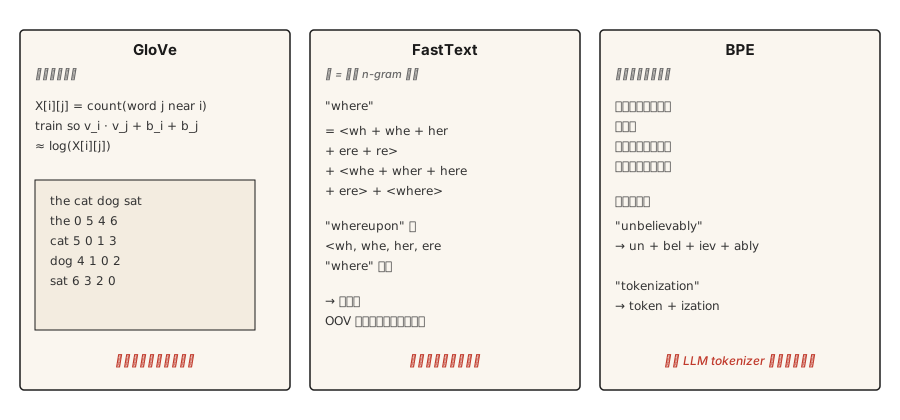
GloVe(Global Vectors)。 构建词-词共现矩阵 X,其中 X[i][j] 表示词 j 在词 i 的上下文中出现多少次。训练向量使得 v_i · v_j + b_i + b_j ≈ log(X[i][j])。给损失加权,避免高频词对主导。搞定。
FastText。 一个词是其字符 n-gram 加上词本身的和。where 变成 <wh, whe, her, ere, re>, <where>。词向量是这些组成向量的和。像 Word2Vec 一样训练。好处是未见过的词(whereupon)可以由已知的 n-gram 组合出来。
BPE(Byte-Pair Encoding)。 从单个字节(或字符)的词汇表开始。统计语料中每对相邻符号,把最频繁的一对合并成一个新 token。重复 k 次。结果是一个 k + 256 大小的词汇表,其中频繁序列(ing、tion、the)是单个 token,罕见词被拆成熟悉的片段。任何句子都能被 tokenize。
构建它
GloVe:分解共现矩阵
pythonimport numpy as np
from collections import Counter
def build_cooccurrence(docs, window=5):
pair_counts = Counter()
vocab = {}
for doc in docs:
for token in doc:
if token not in vocab:
vocab[token] = len(vocab)
for doc in docs:
indexed = [vocab[t] for t in doc]
for i, center in enumerate(indexed):
for j in range(max(0, i - window), min(len(indexed), i + window + 1)):
if i != j:
distance = abs(i - j)
pair_counts[(center, indexed[j])] += 1.0 / distance
return vocab, pair_counts
def glove_train(vocab, pair_counts, dim=16, epochs=100, lr=0.05, x_max=100, alpha=0.75, seed=0):
n = len(vocab)
rng = np.random.default_rng(seed)
W = rng.normal(0, 0.1, size=(n, dim))
W_tilde = rng.normal(0, 0.1, size=(n, dim))
b = np.zeros(n)
b_tilde = np.zeros(n)
for epoch in range(epochs):
for (i, j), x_ij in pair_counts.items():
weight = (x_ij / x_max) ** alpha if x_ij < x_max else 1.0
diff = W[i] @ W_tilde[j] + b[i] + b_tilde[j] - np.log(x_ij)
coef = weight * diff
grad_W_i = coef * W_tilde[j]
grad_W_tilde_j = coef * W[i]
W[i] -= lr * grad_W_i
W_tilde[j] -= lr * grad_W_tilde_j
b[i] -= lr * coef
b_tilde[j] -= lr * coef
return W + W_tilde有两个值得指出的细节。加权函数 f(x) = (x/x_max)^alpha 压低极频繁词对(如 (the, and))的损失,防止它们主导总损失。最终嵌入是中心表 W 和上下文表 W_tilde 之和。把两个表相加是文献中的技巧,通常比只用其中一个更好。
FastText:子词感知嵌入
pythondef char_ngrams(word, n_min=3, n_max=6):
wrapped = f"<{word}>"
grams = {wrapped}
for n in range(n_min, n_max + 1):
for i in range(len(wrapped) - n + 1):
grams.add(wrapped[i:i + n])
return gramspython>>> char_ngrams("where")
{'<where>', '<wh', 'whe', 'her', 'ere', 're>', '<whe', 'wher', 'here', 'ere>', '<wher', 'where', 'here>'}每个词由其 n-gram 集合(通常 3 到 6 个字符)表示。词嵌入是其 n-gram 嵌入之和。对 skip-gram 训练,把原来 Word2Vec 用单个向量的地方换成这个。
pythondef fasttext_vector(word, ngram_table):
grams = char_ngrams(word)
vecs = [ngram_table[g] for g in grams if g in ngram_table]
if not vecs:
return None
return np.sum(vecs, axis=0)对未见词,只要它的一些 n-gram 已知,仍然可以得到向量。whereupon 与 where 共享 <wh、her、ere、<where,因此两者在空间中靠近。
BPE:学习子词词汇表
pythondef learn_bpe(corpus, k_merges):
vocab = Counter()
for word, freq in corpus.items():
tokens = tuple(word) + ("</w>",)
vocab[tokens] = freq
merges = []
for _ in range(k_merges):
pair_freq = Counter()
for tokens, freq in vocab.items():
for a, b in zip(tokens, tokens[1:]):
pair_freq[(a, b)] += freq
if not pair_freq:
break
best = pair_freq.most_common(1)[0][0]
merges.append(best)
new_vocab = Counter()
for tokens, freq in vocab.items():
new_tokens = []
i = 0
while i < len(tokens):
if i + 1 < len(tokens) and (tokens[i], tokens[i + 1]) == best:
new_tokens.append(tokens[i] + tokens[i + 1])
i += 2
else:
new_tokens.append(tokens[i])
i += 1
new_vocab[tuple(new_tokens)] = freq
vocab = new_vocab
return merges
def apply_bpe(word, merges):
tokens = list(word) + ["</w>"]
for a, b in merges:
new_tokens = []
i = 0
while i < len(tokens):
if i + 1 < len(tokens) and tokens[i] == a and tokens[i + 1] == b:
new_tokens.append(a + b)
i += 2
else:
new_tokens.append(tokens[i])
i += 1
tokens = new_tokens
return tokenspython>>> corpus = Counter({"low": 5, "lower": 2, "newest": 6, "widest": 3})
>>> merges = learn_bpe(corpus, k_merges=10)
>>> apply_bpe("lowest", merges)
['low', 'est</w>']第一次迭代合并最常见的相邻对。经过足够多次迭代,频繁子串(low、est、tion)变成单个 token,罕见词也会被干净地拆分。
真实的 GPT / BERT / T5 tokenizer 会学习 3 万-10 万次合并。结果:任何文本都能 tokenize 成已知 ID 的有限长度序列,永远没有 OOV。
使用它
实践中,你很少自己训练这些,而是加载预训练 checkpoint。
pythonimport fasttext.util
fasttext.util.download_model("en", if_exists="ignore")
ft = fasttext.load_model("cc.en.300.bin")
print(ft.get_word_vector("whereupon").shape)
print(ft.get_word_vector("zoomerapproved").shape)Transformer 时代的 BPE 式子词 tokenization:
pythonfrom transformers import AutoTokenizer
tok = AutoTokenizer.from_pretrained("gpt2")
print(tok.tokenize("unbelievably tokenized"))['un', 'bel', 'iev', 'ably', 'Ġtoken', 'ized']Ġ 前缀标记词边界(GPT-2 的约定)。每个现代 tokenizer 都是 BPE 变体、WordPiece(BERT)或 SentencePiece(T5、LLaMA)。
何时选哪个
| 场景 | 选择 |
|---|---|
| 预训练通用词向量,不需要容忍 OOV | GloVe 300d |
| 预训练通用词向量,必须处理拼写错误 / 新造词 / 形态丰富语言 | FastText |
| 任何进入 Transformer 的数据(训练或推理) | 用模型附带的 tokenizer。绝不能换。 |
| 从头训练自己的语言模型 | 先在语料上训练 BPE 或 SentencePiece tokenizer |
| 生产文本分类用线性模型 | 仍然用 TF-IDF。第 02 课。 |
交付它
保存为 outputs/skill-embeddings-picker.md:
markdown---
name: tokenizer-picker
description: Pick a tokenization approach for a new language model or text pipeline.
version: 1.0.0
phase: 5
lesson: 04
tags: [nlp, tokenization, embeddings]
---
Given a task and dataset description, you output:
1. Tokenization strategy (word-level, BPE, WordPiece, SentencePiece, byte-level). One-sentence reason.
2. Vocabulary size target (e.g., 32k for an English-only LM, 64k-100k for multilingual).
3. Library call with the exact training command. Name the library. Quote the arguments.
4. One reproducibility pitfall. Tokenizer-model mismatch is the single most common silent production bug; call out which pair must be used together.
Refuse to recommend training a custom tokenizer when the user is fine-tuning a pretrained LLM. Refuse to recommend word-level tokenization for any model targeting production inference. Flag non-English / multi-script corpora as needing SentencePiece with byte fallback.练习
- 简单。 运行
char_ngrams("playing")和char_ngrams("played")。计算两个 n-gram 集合的 Jaccard 重叠。你会看到大量共享片段(pla、lay、play),这正是 FastText 能跨形态变体迁移的原因。 - 中等。 扩展
learn_bpe,追踪词汇表增长。绘制「每个语料字符对应的 token 数」随合并次数变化的曲线。开始会快速压缩,最终渐近于每个 token 约 2-3 个字符。 - 困难。 在莎士比亚全集上训练一个 1k 次合并的 BPE。比较常见词与罕见专有名词的 tokenization。测量合并前后的平均每词 token 数。写下让你惊讶的地方。
关键术语
| 术语 | 人们的说法 | 实际含义 |
|---|---|---|
| Co-occurrence matrix | 词-词频率表 | X[i][j] = 词 j 在词 i 窗口内出现的次数。 |
| Subword | 词的片段 | 字符 n-gram(FastText)或学习到的 token(BPE/WordPiece/SentencePiece)。 |
| BPE | 字节对编码 | 反复合并最频繁的相邻对,直到词汇表达到目标大小。 |
| OOV | 词表外 | 模型从未见过的词。Word2Vec/GloVe 无法处理;FastText 和 BPE 可以。 |
| Byte-level BPE | 原始字节上的 BPE | GPT-2 的方案。词汇表从 256 个字节开始,因此永远没有 OOV。 |
延伸阅读
- Pennington, Socher, Manning (2014). GloVe: Global Vectors for Word Representation —— GloVe 论文,七页,仍是损失函数推导的最佳来源。
- Bojanowski et al. (2017). Enriching Word Vectors with Subword Information —— FastText。
- Sennrich, Haddow, Birch (2016). Neural Machine Translation of Rare Words with Subword Units —— 把 BPE 引入现代 NLP 的论文。
- Hugging Face tokenizer summary —— BPE、WordPiece 和 SentencePiece 在实践中究竟有何不同。
示意图共 1 张