问题
一个编码 Agent 在对话的每一轮都把同一段 15,000 token 的 system prompt 发给 Claude。二十轮,按每百万输入 token 3 美元计算,光输入成本就是 0.90 美元——这还没算用户实际发送的任何消息。乘以每天 10,000 次对话,这些从不改变的文字每天要烧掉 9,000 美元。
你没法在不损害质量的前提下缩短 prompt,也没法不发它——模型每一轮都需要它。唯一的出路,是不要再为提供商已经见过的前缀付全价。
这条出路就是 prompt caching。Anthropic 在 2024 年 8 月推出它(2025 年增加了 1 小时延长 TTL 版本),OpenAI 在那年晚些时候实现了自动缓存,Google 随 Gemini 1.5 推出了显式上下文缓存,如今三家都在各自的前沿模型上把它作为一等特性提供。
概念
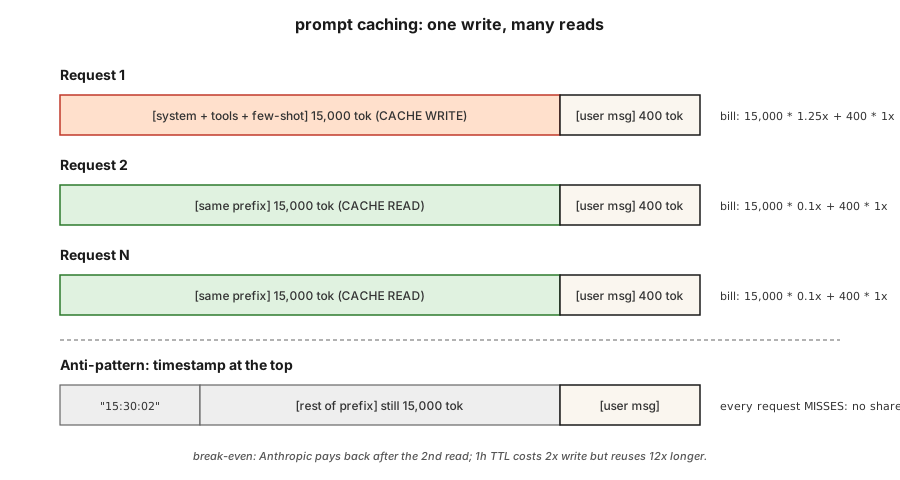
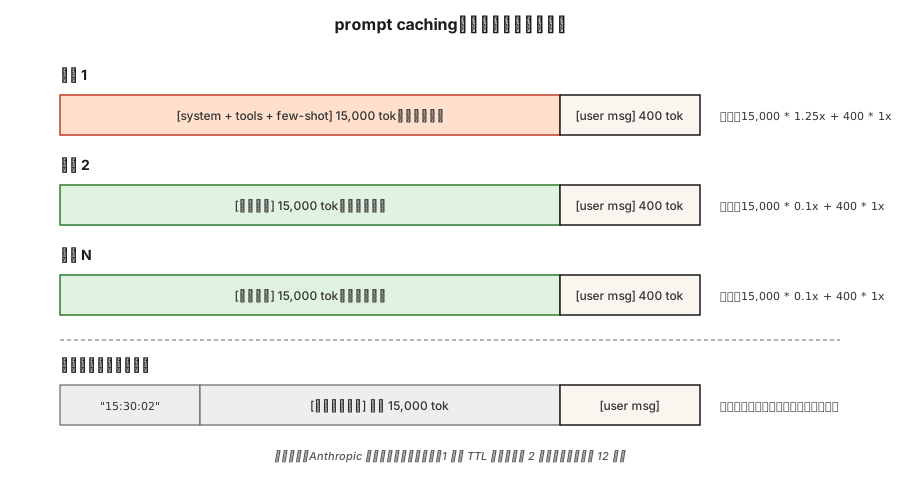
机制。 当请求的前缀与最近某次请求的前缀匹配时,提供商直接复用上一轮运行留下的 KV cache,而不是重新编码这些 token。第一次你支付一笔较小的写入溢价,之后每次读取都享受大幅折扣。
2026 年的三种提供商方案。
| 提供商 | API 风格 | 命中折扣 | 写入溢价 | 默认 TTL | 最小可缓存量 |
|---|---|---|---|---|---|
| Anthropic | 在内容块上显式标记 cache_control | 输入费用减免 90% | 加价 25% | 5 分钟(可延长至 1 小时) | 1,024 token(Sonnet/Opus),2,048(Haiku) |
| OpenAI | 自动前缀检测 | 输入费用减免 50% | 无 | 最长 1 小时(尽力而为) | 1,024 token |
| Google (Gemini) | 显式 CachedContent API | 按存储计费;读取约为正常的 25% | 按 token·小时收存储费 | 用户设定(默认 1 小时) | 4,096 token(Flash),32,768(Pro) |
不变式。 三家都只缓存前缀。只要请求之间有一个 token 不同,第一个不同 token 之后的内容全部未命中。把稳定的部分放在最上面,把可变的部分放在最下面。
缓存友好的布局
[system prompt] <-- cache this
[tool definitions] <-- cache this
[few-shot examples] <-- cache this
[retrieved documents] <-- cache if reused, else don't
[conversation history] <-- cache up to last turn
[current user message] <-- never cache (different every time)打乱这个顺序——把用户消息放到 system prompt 上面、在 few-shot 之间穿插动态检索结果——缓存就永远不会命中。
盈亏平衡计算
Anthropic 25% 的写入溢价意味着,一个缓存块至少要读取两次才能在净额上省钱。一次写入加一次读取,平均每次请求成本为 0.675x(节省 32%);一次写入加十次读取,平均为 0.205x(节省 80%)。经验法则:只要预期在 TTL 内至少复用 3 次,就值得缓存。
构建它
步骤 1:使用显式标记的 Anthropic prompt 缓存
pythonimport anthropic
client = anthropic.Anthropic()
SYSTEM = [
{
"type": "text",
"text": "You are a senior Python reviewer. Follow the rubric exactly.\n\n" + RUBRIC_15K_TOKENS,
"cache_control": {"type": "ephemeral"},
}
]
def review(code: str):
return client.messages.create(
model="claude-opus-4-7",
max_tokens=1024,
system=SYSTEM,
messages=[{"role": "user", "content": code}],
)cache_control 标记告诉 Anthropic 把这个块保存 5 分钟。窗口内复用会命中;窗口外复用则过期并重新写入。
响应中的用量字段:
pythonresponse = review(code_a)
response.usage
# InputTokensUsage(
# input_tokens=120,
# cache_creation_input_tokens=15023, # paid at 1.25x
# cache_read_input_tokens=0,
# output_tokens=340,
# )
response_b = review(code_b)
response_b.usage
# cache_creation_input_tokens=0
# cache_read_input_tokens=15023 # paid at 0.1x在 CI 中检查这两个字段——如果多次请求之间 cache_read_input_tokens 一直是零,说明你的缓存键在漂移。
步骤 2:一小时延长 TTL
对于长时间运行的批处理任务,5 分钟的默认值会在两个任务之间过期。设置 ttl:
python{"type": "text", "text": RUBRIC, "cache_control": {"type": "ephemeral", "ttl": "1h"}}1 小时 TTL 的写入溢价是 2 倍(相对基线加价 50%,而非 25%),但只要某个 batch 在 TTL 内复用前缀超过 5 次,就很快回本。
步骤 3:OpenAI 自动缓存
OpenAI 没有任何东西需要你配置。任何超过 1,024 token 且与近期请求匹配的前缀,都会自动获得 50% 折扣。
pythonfrom openai import OpenAI
client = OpenAI()
resp = client.chat.completions.create(
model="gpt-5",
messages=[
{"role": "system", "content": SYSTEM_PROMPT}, # long and stable
{"role": "user", "content": user_msg},
],
)
resp.usage.prompt_tokens_details.cached_tokens # the discounted portion缓存友好的布局规则同样适用。有两件事会破坏 OpenAI 的缓存,却不影响 Anthropic:改变 user 字段(它被用作缓存键的一部分),以及重排工具顺序。
步骤 4:Gemini 显式上下文缓存
Gemini 把缓存当作一等对象,由你创建并命名:
pythonfrom google import genai
from google.genai import types
client = genai.Client()
cache = client.caches.create(
model="gemini-3.8-flash",
config=types.CreateCachedContentConfig(
display_name="rubric-v3",
system_instruction=RUBRIC,
contents=[FEW_SHOT_EXAMPLES],
ttl="3600s",
),
)
resp = client.models.generate_content(
model="gemini-3.8-flash",
contents=["Review this code:\n" + code],
config=types.GenerateContentConfig(cached_content=cache.name),
)Gemini 按 token·小时收取存储费,只要缓存存在就一直计费;读取约为正常输入费率的 25%。当你需要在多天内、跨大量会话复用同一段超长 prompt 时,这是正确的形态。
步骤 5:在生产中测量命中率
参见 code/main.py,其中有一个模拟的三提供商记账器,追踪 write/read/miss 次数,并计算每 1K 请求的综合成本。把目标命中率作为部署门禁——大多数生产环境的 Anthropic 配置在预热后应达到 80% 以上的读取比例。
2026 年仍在踩的坑
- 顶部放动态时间戳。 system prompt 开头写着
"Current time: 2026-04-22 15:30:02",每次请求都会未命中。把时间戳移到缓存断点下方。 - 工具重排。 以稳定的顺序序列化工具——部署之间一次 dict 重排就会破坏所有命中。
- 自由文本的近重复。 "You are helpful." 与 "You are a helpful assistant."——一个字节之差就是完全未命中。
- 块太小。 Anthropic 强制执行 1,024 token 的下限(Haiku 为 2,048)。更小的块会静默地不被缓存。
- 盲目的成本仪表盘。 把「输入 token」拆成已缓存和未缓存两部分。否则流量下降看起来会像缓存收益。
使用它
2026 年的缓存技术栈:
| 场景 | 选择 |
|---|---|
| Agent,稳定的 10k+ system prompt,多轮对话 | Anthropic cache_control,5 分钟 TTL |
| 批处理任务,前缀复用 30 分钟以上 | Anthropic,ttl: "1h" |
| GPT-5 上的无服务器端点,无自建基础设施 | OpenAI 自动缓存(只需让前缀稳定且足够长) |
| 多天复用大型代码/文档语料 | Gemini 显式 CachedContent |
| 跨提供商回退 | 让可缓存前缀的布局在各提供商之间保持一致,这样任何一处命中都有效 |
与语义缓存(Phase 11 · 11)结合,覆盖用户消息层:prompt 缓存处理 token 完全一致的复用,语义缓存处理语义相同的复用。
交付它
保存 outputs/skill-prompt-caching-planner.md:
markdown---
name: prompt-caching-planner
description: Design a cache-friendly prompt layout and pick the right provider caching mode.
version: 1.0.0
phase: 11
lesson: 15
tags: [llm-engineering, caching, cost]
---
Given a prompt (system + tools + few-shot + retrieval + history + user) and a usage profile (requests per hour, TTL needed, provider), output:
1. Layout. Reordered sections with a single cache breakpoint marked; explain which sections are stable, which are volatile.
2. Provider mode. Anthropic cache_control, OpenAI automatic, or Gemini CachedContent. Justify from TTL and reuse pattern.
3. Break-even. Expected reads per write within TTL; net cost vs no-cache with math.
4. Verification plan. CI assertion that cache_read_input_tokens > 0 on the second identical request; dashboard split by cached vs uncached tokens.
5. Failure modes. List the three most likely reasons the cache will miss in this setup (dynamic timestamp, tool reorder, near-duplicate text) and how you will prevent each.
Refuse to ship a cache plan that places a dynamic field above the breakpoint. Refuse to enable 1h TTL without a reuse count that makes the 2x write premium pay back.练习
- 简单。 针对 Claude 跑一段 10 轮对话,system prompt 为 5,000 token。先不用
cache_control跑一遍,再启用跑一遍。报告各自的输入 token 账单。 - 中等。 编写一个测试框架:给定 prompt 模板和请求日志,计算每种提供商(Anthropic 5 分钟、Anthropic 1 小时、OpenAI 自动、Gemini 显式)下的预期命中率和美元节省额。
- 困难。 构建一个布局优化器:给定一个 prompt 和一组标记为
stable=True/False的字段,重写 prompt,在不丢失信息的前提下把唯一的缓存断点放在最利于缓存的位置。在真实的 Anthropic 端点上验证。
关键术语
| 术语 | 大家的说法 | 实际含义 |
|---|---|---|
| Prompt caching | 「让长 prompt 变便宜」 | 对匹配前缀复用提供商侧的 KV cache;重复输入 token 享受 50-90% 折扣。 |
cache_control | 「Anthropic 的标记」 | 内容块属性,声明「直到这里的内容都可缓存」;{"type": "ephemeral"}。 |
| Cache write | 「支付溢价」 | 第一次填充缓存的请求;Anthropic 按约 1.25x 输入费率计费,OpenAI 免费。 |
| Cache read | 「折扣」 | 后续匹配该前缀的请求;按 10%(Anthropic)、50%(OpenAI)、约 25%(Gemini)计费。 |
| TTL | 「缓存能活多久」 | 缓存保持温热的秒数;Anthropic 默认 5 分钟(可延长至 1 小时),OpenAI 尽力维持最长 1 小时,Gemini 由用户设定。 |
| Extended TTL | 「Anthropic 的 1 小时缓存」 | {"type": "ephemeral", "ttl": "1h"};写入溢价 2 倍,但批处理复用时值得。 |
| Prefix match | 「我的缓存为什么没命中」 | 只有当从开头到断点的每一个 token 都字节级一致时,缓存才会命中。 |
| Context caching (Gemini) | 「显式的那种」 | Google 的具名、按存储计费的缓存对象;最适合大型语料的多天复用。 |
延伸阅读
- Anthropic — Prompt caching ——
cache_control、1 小时 TTL、盈亏平衡表。 - OpenAI — Prompt caching —— 自动前缀匹配。
- Google — Context caching ——
CachedContentAPI 与存储定价。 - Anthropic engineering — Prompt caching for long-context workloads —— 原始发布文章,含延迟数据。
- Phase 11 · 05(Context Engineering)—— 在哪里切分 prompt,才能让缓存落地。
- Phase 11 · 11(Caching and Cost)—— 把 prompt 缓存与用户消息上的语义缓存配合使用。
- Pope et al., "Efficiently Scaling Transformer Inference" (2022) —— prompt 缓存暴露给用户的 KV-cache 内存模型;解释了为什么缓存前缀的重新读取成本约为重新计算的 1/10。
- Agrawal et al., "SARATHI: Efficient LLM Inference by Piggybacking Decodes with Chunked Prefills" (2023) —— prefill 正是 prompt 缓存所绕过的阶段;这篇论文解释了为什么命中缓存时 TTFT 大幅下降,而 TPOT 不受影响。
- Leviathan et al., "Fast Inference from Transformers via Speculative Decoding" (2023) —— prompt 缓存与推测解码、Flash Attention、MQA/GQA 一样,都是弯折推理成本曲线的杠杆;读这篇可以了解另外三个。
示意图共 1 张