- Compute a log-Mel spectrogram from a waveform: windowing, FFT, filter banks, log transform.
- Compare encoder options: Whisper encoder, BEATs, AF-Whisper hybrid. When each wins.
- Build an audio Q-former: N learnable queries cross-attending to spectrogram patches.
- Explain cascaded (Whisper-then-LLM) vs end-to-end audio-LLM training: why end-to-end scales better for reasoning.
The Problem
Speech recognition was solved by Whisper. OCR-of-audio is a commodity. But "commodity" stops at transcription. If the model cannot reason over what it heard — timing, speakers, emotion, music structure, environmental sounds — transcription alone cannot drive product features.
Three obvious routes:
- Cascade: Whisper transcribes, LLM reasons over the transcript. Works for pure-speech scenarios. Fails for music, environmental audio, multi-speaker overlap, emotion.
- End-to-end audio-LLM: an audio encoder feeds audio tokens directly into an LLM, skipping transcription. Preserves acoustic information (emotion, speaker, environment). Needs new training data.
- Hybrid: audio encoder + text decoder that can both transcribe and reason. Qwen-Audio and Audio Flamingo pick this route.
The Concept
Log-Mel spectrogram: the input feature
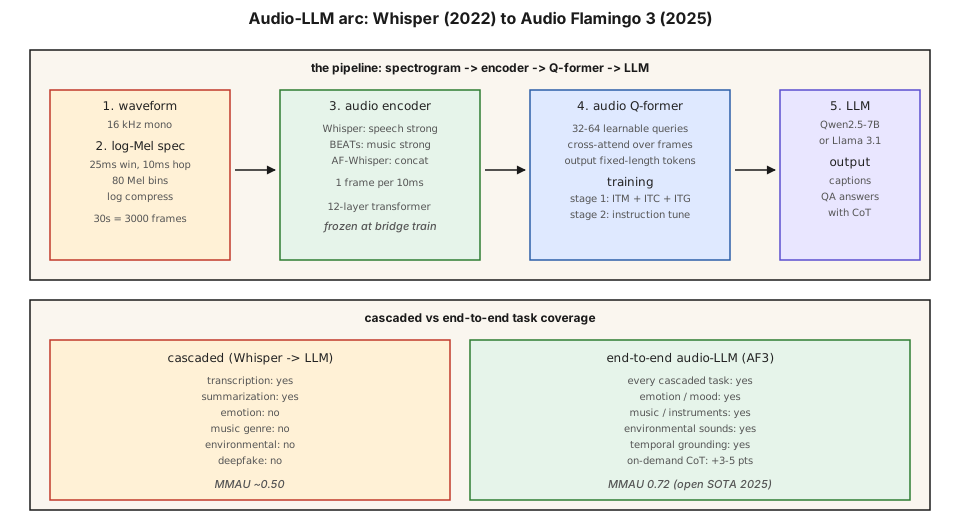
Every audio encoder starts with the same feature: a log-Mel spectrogram.
- Resample to 16 kHz.
- Short-time Fourier transform with 25ms windows, 10ms hop.
- Take magnitude of the FFT result.
- Apply Mel filter banks (typically 80 filters log-spaced 0-8000 Hz) to warp to perceptual frequency.
- Log compress (\log(1 + x)) for dynamic range.
Result: a 2D array of shape (T, 80) where T is the number of time frames. For a 30-second clip at 100 Hz frame rate: (3000, 80).
Whisper's encoder
Whisper's encoder is a 12-layer ViT-style transformer processing the log-Mel spectrogram as a sequence of time frames. Output: one hidden-state vector per time frame.
For ASR, Whisper's decoder is a cross-attention transformer that generates text tokens conditioned on the encoder output. Standard encoder-decoder.
For ALMs (audio-LLMs), you want the encoder output as input to a different LLM. The pattern: Whisper encoder frozen, Q-former trainable, LLM frozen or tuned.
BEATs and audio-specific encoders
Whisper was trained on speech-dominant data. It is weaker for music and environmental audio.
BEATs (Chen et al., 2022) is a self-supervised transformer trained on AudioSet. Captures music and environmental sounds better than Whisper at the same parameter count.
AF-Whisper (Audio Flamingo 3's hybrid): concat Whisper + BEATs features as the audio input. Whisper carries linguistic signal, BEATs carries acoustic signal.
Audio Q-former
Same pattern as BLIP-2's visual Q-former. A fixed number of learnable queries (often 32 or 64) cross-attend over the audio encoder's output frames. The queries become audio tokens consumed by the LLM.
Training alignment stage: Q-former alone, contrastive + captioning losses on audio-text pairs (AudioCaps, Clotho). Instruction stage: end-to-end, unfreeze LLM, train on instruction data.
The arc — SALMONN, Qwen-Audio, AF3
SALMONN (Tang et al., 2023): Whisper + BEATs + Q-former + LLaMA. The first open audio-LLM with serious reasoning ability. Benchmarks on MMAU show ~0.55 composite.
Qwen-Audio (Chu et al., 2023): similar architecture, trained on a richer dataset, tuned for multi-turn dialogue. MMAU ~0.60.
LTU — Listen, Think, Understand (Gong et al., 2023): explicit reasoning data, focus on chain-of-thought over audio clips. Smaller but more focused.
Audio Flamingo 3 (Goel et al., July 2025): the current open SOTA. 8B LLM backbone (Qwen2 7B), Whisper-large encoder concat BEATs, 64-query Q-former, training on 1M+ audio-text instruction pairs. MMAU 0.72, matches proprietary frontier on some sub-tasks.
AF3 also introduces on-demand chain-of-thought for audio: the model can optionally emit thinking tokens ("let me identify the instruments first: ...") before the final answer. Accuracy on complex reasoning tasks lifts 3-5 points when thinking is enabled.
Cascaded vs end-to-end
Cascaded pipeline:
- Whisper transcribes audio → text.
- LLM reasons over text.
Works perfectly for "summarize this podcast." Fails for:
- "What's the mood of this song?" — mood is in the sound, not words.
- "Who is speaking, Alice or Bob?" — requires speaker identification.
- "At what second does the explosion happen?" — temporal grounding lost in text.
- "Is this real or generated audio?" — deepfake detection needs acoustic features.
End-to-end preserves acoustic signal. Qwen-Audio and AF3 handle music, environment, and emotion natively.
2026 production recipe
For a new audio-understanding product:
- Cascaded if: transcription is the goal, no music, no emotion inference.
- AF3 / Qwen-Audio-family if: music, emotion, multi-speaker, or complex audio reasoning.
Cascaded is cheaper and simpler. End-to-end is more capable.
MMAU — the audio reasoning benchmark
MMAU (Massive Multimodal Audio Understanding) is the 2024-2025 audio reasoning benchmark:
- 10,000 audio-text QA pairs across speech, music, environmental sounds.
- Covers classification, temporal reasoning, causal reasoning, open-ended QA.
- Tests what cascaded pipelines systematically miss.
Open SOTA (AF3) at 0.72; proprietary frontier ~0.78 (Gemini 2.5 Pro, Claude Opus 4.7). The gap is smaller than VideoMME's open-vs-closed delta, indicating audio-LLMs are maturing.
Use It
code/main.py:
- Implements log-Mel spectrogram computation in stdlib: windowing, naive DFT, Mel filter-bank.
- Audio Q-former skeleton: given encoder output frames, compute Q, K, V, attention, and emit N tokens.
- Cascaded-vs-end-to-end comparison on a toy task.
Ship It
This lesson produces outputs/skill-audio-llm-pipeline-picker.md. Given an audio task (transcription, music tagging, emotion inference, multi-speaker diarization, environment classification), it picks cascaded, end-to-end AF3, or a hybrid.
Exercises
- Compute the log-Mel spectrogram dimension for a 30-second clip at 16kHz, 25ms window, 10ms hop, 80 Mel bins. How does this change at 48kHz?
- Why does Whisper underperform on music? What audio features does BEATs capture that Whisper does not?
- Audio Q-former with 64 queries vs 32: at what task complexity does 64 pay off? 32 save compute for what?
- Read AF3 Section 4 on on-demand thinking. Propose three audio tasks where chain-of-thought helps the most.
- Implement a minimal diarization pipeline using AF3's output. How do you signal speaker changes?
Key Terms
| Term | What people say | What it actually means |
|---|---|---|
| Log-Mel spectrogram | "Mel features" | 2D (time, frequency) array of log-magnitude values after Mel filter banks |
| Audio Q-former | "Audio Perceiver" | Cross-attention bottleneck from audio encoder output to fixed-length queries feeding the LLM |
| Cascaded | "ASR-then-LLM" | Pipeline where Whisper transcribes and a text LLM reasons; loses acoustic information |
| End-to-end | "Audio-LLM" | Audio features enter the LLM directly via Q-former; preserves acoustic signal |
| BEATs | "Audio AudioSet encoder" | SSL transformer trained on AudioSet; strong on music + environmental sounds |
| MMAU | "Audio reasoning bench" | 10k QA pairs across speech, music, environment; 2024 eval standard |
| On-demand thinking | "Audio CoT" | Model can optionally emit reasoning tokens before final answer, lifts accuracy 3-5 pts |
Further Reading
- Radford et al. — Whisper (arXiv:2212.04356)
- Chu et al. — Qwen-Audio (arXiv:2311.07919)
- Goel et al. — Audio Flamingo 3 (arXiv:2507.08128)
- Tang et al. — SALMONN (arXiv:2310.13289)
- Gong et al. — LTU (arXiv:2305.10790)
Diagrams1 figure