- Design a shared vocabulary that hosts text, image, speech, and music tokens without collisions.
- Compare SEED-Tokenizer (images) and SpeechTokenizer residual-VQ (speech) on compression + reconstruction trade-offs.
- Explain the four-stage curriculum that builds up any-to-any generation.
- Name the three open any-to-any recipes and their main trade-offs: MIO, AnyGPT, Unified-IO 2.
The Problem
A unified multimodal model is easy to claim and hard to build at scale. Most "any-to-any" systems until 2024 were pipelined: vision model → text representation → speech model → audio. Each hop loses information, adds latency, and complicates training. GPT-4o's demo video showed a single-model alternative with subsecond response; open systems trailed by months.
The engineering challenges:
- Tokenizers must exist for every modality, compress losslessly-enough for reconstruction, and produce tokens at rates the transformer can consume.
- A single vocabulary must allocate space for text (32k+), image (16k+), speech (4k+), music (8k+). Forty-thousand-plus entries minimum.
- Training data must cover every input-output pair (text→image, image→speech, speech→image, etc.) or the model must compose.
- Inference must stream output tokens fast enough for conversational latency (<500ms time-to-first-audio-byte).
The Concept
Four tokenizers for four modalities
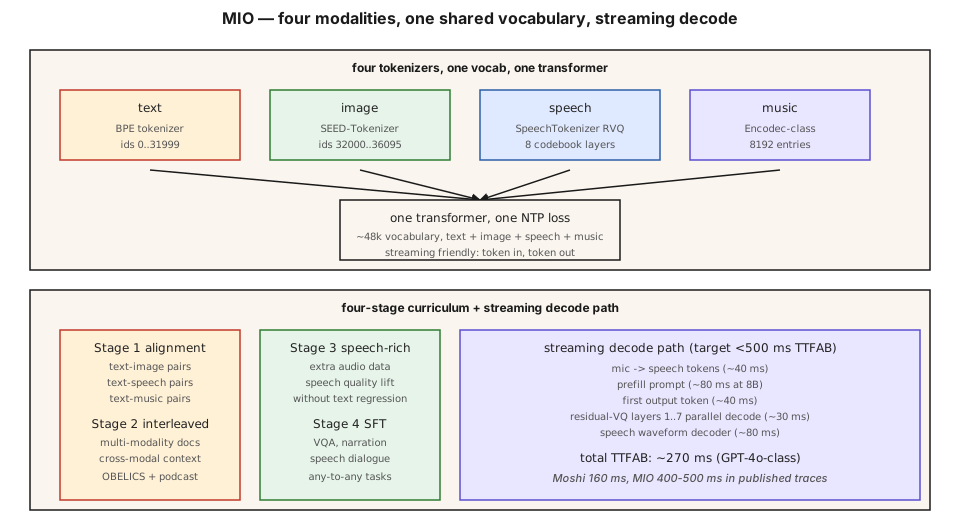
MIO's tokenizer stack:
- Text: standard BPE, vocab ~32000.
- Image: SEED-Tokenizer (2023) — quantized VAE with discrete codebook, 4096 entries, 32x32 tokens per image.
- Speech: SpeechTokenizer residual-VQ (2023) — encodes 16kHz waveform into 8 hierarchical codebooks; first level is coarse content, later levels add prosody and speaker identity.
- Music: similar residual-VQ (Meta's MusicGen / Encodec family), 4-8 codebooks.
Each modality produces integer tokens. The tokens get disjoint ID ranges in the shared vocabulary:
text: 0..31999
image: 32000..36095 (4096 image tokens)
speech: 36096..40191 (4096 speech base tokens, plus residual layers)
music: 40192..48383 (8192 music tokens)
sep: 48384..48390 (<image>, <speech>, <music>, </...>, etc.)Total: ~48k vocabulary. The input embedding and output projection span all of it.
Streaming decode
Speech generation uses residual-VQ. The transformer predicts the base (layer 0) speech tokens; a parallel-decoded residual quantizer predicts the subsequent layers. Each layer 0 token is roughly 50ms of audio at 16kHz.
The streaming pattern:
- User speaks into mic; real-time audio tokenizer emits speech tokens every 50ms.
- MIO consumes tokens as they arrive (prompt prefill + incremental forward).
- Output tokens stream out as generated; a parallel speech decoder converts them to audio samples with ~50-150ms latency.
- Time-to-first-audio-byte: ~300-500ms in MIO paper, approaching GPT-4o's ~250ms.
Mini-Omni (arXiv:2408.16725), GLM-4-Voice (arXiv:2412.02612), and Moshi (arXiv:2410.00037) are complementary streaming speech-LLM designs. Moshi in particular achieves 160ms round-trip on a single GPU.
Four-stage curriculum
MIO's training curriculum:
- Stage 1 — alignment. Large-scale modality-pair corpora: text-image, text-speech, text-music. Each pair uses its own token vocabulary segment. Trains the shared vocabulary.
- Stage 2 — interleaved. Multi-modality interleaved documents (blogs with images + video, podcasts with transcripts, etc.). Trains cross-modality context.
- Stage 3 — speech-enhanced. Extra audio data to lift speech quality without losing text capability.
- Stage 4 — SFT. Instruction tuning across modalities: VQA, captioning, narration, speech-to-speech dialogue.
Missing a stage degrades specific capabilities: skip stage 2 and the model loses cross-modality context; skip stage 3 and speech is poor.
Chain-of-visual-thought
MIO introduces chain-of-visual-thought: the model emits intermediate image tokens as a reasoning step. For "is the cat climbing a tree?" the model:
- Emits
<image>tokens rendering the scene (from the input image or a sketch). - Emits text analyzing the sketch.
- Emits the final answer.
The rendered intermediate image serves as a scratchpad. Benchmarks improve on spatial-reasoning tasks. The idea mirrors chain-of-thought for text reasoning.
Competitors in any-to-any
- AnyGPT (arXiv:2402.12226): 4 modalities (text, image, speech, music), similar design.
- Unified-IO 2 (arXiv:2312.17172): adds vision action outputs, depth, normals. More task diversity, smaller scale.
- NExT-GPT (arXiv:2309.05519): LLM + modality-specific diffusion decoders. Not a single-model approach.
- CoDi (arXiv:2305.11846): composable diffusion; any-to-any via shared latent.
MIO is the closest to pure-token any-to-any. AnyGPT is its conceptual ancestor.
Latency budget
For a conversational product, every component's latency matters:
- Mic to audio tokens: ~50ms.
- Prefill (audio tokens + history): ~100ms on an 8B model.
- First output token: ~50ms.
- Parallel residual-VQ + speech decoder: ~100-150ms.
Total time-to-first-audio-byte: ~300ms minimum. GPT-4o claims ~250ms. Moshi claims 160ms. MIO/AnyGPT are in the 400-600ms range per public benchmarks.
Why any-to-any stays hard
Even in 2026, open any-to-any models trail closed ones on two axes:
- Speech quality. The residual-VQ tokenizer is lossy; conversational speech sounds robotic compared to ElevenLabs-class voices.
- Cross-modality reasoning. Asking the model "sing about what you see" still fails more often than pure-vision tasks.
These are open research problems. Qwen3-Omni (Lesson 12.20) is the most advanced open attempt in 2025.
Use It
code/main.py:
- Defines the four-modality vocabulary allocation and prints it.
- Routes a list of multimodal inputs (text, image, audio-clip, music) through the tokenizer router.
- Simulates streaming decode for a text-to-speech response with latency counting.
- Computes the expected time-to-first-audio-byte given encoder, prefill, and decoder latencies.
Ship It
This lesson produces outputs/skill-any-to-any-pipeline-auditor.md. Given a conversational product spec (modalities in, modalities out, latency target), it audits the MIO-family design choices and computes the latency budget.
Exercises
- Your product accepts speech input and returns speech output. What's the end-to-end latency budget target? List the components that spend time.
- SpeechTokenizer residual-VQ uses 8 codebooks. Propose why parallel-decoding the residual levels is necessary (vs sequential) and what latency savings it brings.
- Your vocabulary has 32k text + 4k image + 4k speech. Add 8k music and ~10 separators. What is the embedding-matrix parameter cost at hidden dim 4096?
- Chain-of-visual-thought emits an intermediate image. What kinds of questions benefit? What kinds are hurt by the extra tokens?
- Read Moshi (arXiv:2410.00037). Describe its "inner monologue" technique and compare to MIO's chain-of-visual-thought.
Key Terms
| Term | What people say | What it actually means |
|---|---|---|
| Any-to-any | "Multimodal in/out" | A single model that accepts and emits text, image, speech, and music in any direction |
| Residual-VQ | "Speech tokenizer stack" | Multi-codebook tokenization where each layer adds information; base layer is content, later layers are prosody |
| SEED-Tokenizer | "Image codes" | Discrete image tokenizer with 4096-entry codebook used by MIO |
| Chain-of-visual-thought | "Visual scratchpad" | The model generates an intermediate image as a reasoning step before its final answer |
| Time-to-first-audio-byte | "TTFAB" | Latency from user voice to first audio output; <500ms for conversational feel |
| Four-stage curriculum | "Training recipe" | Alignment -> interleaved -> speech-enhanced -> SFT, in that order |
Further Reading
- Wang et al. — MIO (arXiv:2409.17692)
- Zhan et al. — AnyGPT (arXiv:2402.12226)
- Lu et al. — Unified-IO 2 (arXiv:2312.17172)
- Wu et al. — NExT-GPT (arXiv:2309.05519)
- Tang et al. — CoDi (arXiv:2305.11846)
Diagrams1 figure