The Problem
DDPM's reverse process is a 1000-step stochastic walk from \mathcal{N}(0, I) back to the data distribution. DDIM collapsed it to 20-50 deterministic steps. You want fewer steps — ideally one. The blocker is that the ODE solving the reverse process is stiff; the path is curved.
If you could train the model such that the path from noise to data was a straight line, a single Euler step from t=1 to t=0 would work. Flow matching builds this directly: define a straight-line interpolation from x_1 \sim \mathcal{N}(0, I) to x_0 \sim \text{data}, train a vector field v_\theta(x, t) to match its time derivative, integrate at inference.
Rectified flow (Liu 2022) goes further: iteratively straighten the paths with a reflow procedure that produces a progressively closer-to-linear ODE. After two reflow iterations, a 2-step sampler matches 50-step DDPM quality.
The Concept
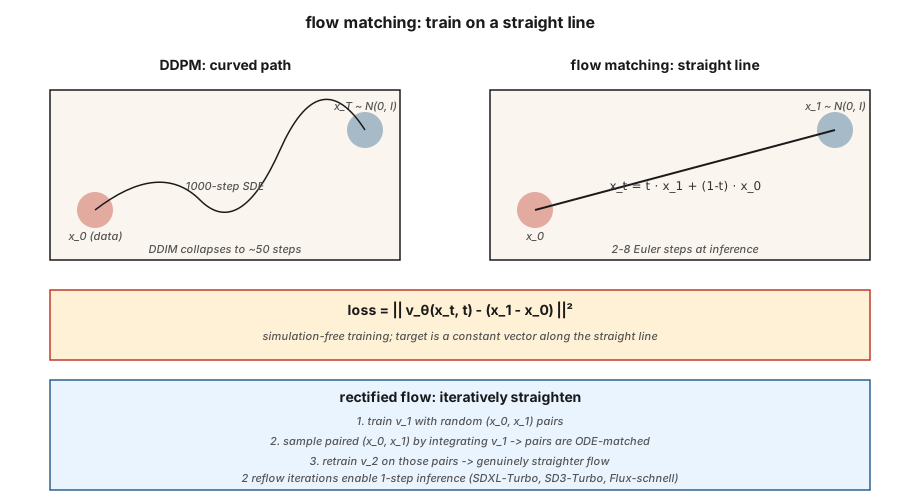
Straight-line flow
Define:
where x_0 \sim \text{data} and x_1 \sim \mathcal{N}(0, I). The time derivative along this straight line is constant:
Define a neural vector field v_\theta(x_t, t) and train it to match this derivative:
This is the conditional flow matching loss (Lipman 2023). Training is simulation-free: you never unroll the ODE. Just sample (x_0, x_1, t) and regress.
Sampling
At inference, integrate the learned vector field backwards in time:
Start at x_1 \sim \mathcal{N}(0, I), Euler-step down to t=0.
Rectified flow (Liu 2022)
Straight-line flow works but the learned paths are not actually straight — they curve because many x_0's can map to the same x_1. Rectified flow's reflow step:
- Train flow model v_1 with random pairings.
- Sample N pairs (x_1, x_0) by integrating v_1 from x_1 to its landing x_0.
- Train v_2 on those paired examples. Because the pairs are now "ODE-matched", the straight-line interpolant between them is genuinely flatter.
- Repeat.
In practice 2 reflow iterations get you to near-linear, enabling 2-4 step inference. SDXL-Turbo, SD3-Turbo, LCM are all distilled-from-flow-matching models.
Why this won for images in 2024
Three reasons:
- Simulation-free training — no ODE unrolling during training, trivial to implement.
- Better loss geometry — straight paths have consistent signal-to-noise, whereas DDPM ε-loss has bad SNR at edges of the schedule.
- Faster inference — 4-8 steps at SDXL-Turbo quality; 1 step with consistency distillation.
Flow matching vs DDPM — the exact connection
Flow matching with a Gaussian-conditional path is diffusion with a specific noise schedule. Pick the x_t = \alpha(t) x_0 + \sigma(t) x_1 schedule and flow matching recovers Stratonovich-reformulated diffusion with v = \alpha' \cdot x_0 - \sigma' \cdot x_1. The two are algebraically equivalent for Gaussian paths.
What flow matching added: the clarity of the target (a plain velocity), a cleaner loss, and the license to experiment with non-Gaussian interpolants.
Build It
code/main.py implements 1-D flow matching on a two-mode Gaussian mixture. The vector field v_\theta(x, t) is a tiny MLP trained with the straight-line target. At inference, integrate 1, 2, 4, and 20 Euler steps and compare sample quality.
Step 1: training loss
pythondef train_step(x0, net, rng, lr):
x1 = rng.gauss(0, 1)
t = rng.random()
x_t = t * x1 + (1 - t) * x0
target = x1 - x0
pred = net_forward(x_t, t)
loss = (pred - target) ** 2
# backprop + updateStep 2: multi-step inference
pythondef sample(net, num_steps):
x = rng.gauss(0, 1)
for i in range(num_steps):
t = 1.0 - i / num_steps
dt = 1.0 / num_steps
x -= dt * net_forward(x, t)
return xStep 3: compare step counts
Expect the 4-step sampler to already match the 20-step quality — a big deal for latency.
Pitfalls
- Time parameterization. Flow matching uses t \in [0, 1] with t=0 at data, t=1 at noise. DDPM uses t \in [0, T] with t=0 at data, t=T at noise. Same direction, different scale. Papers get this wrong constantly.
- Schedule choice. Rectified flow's straight line is "the" flow-matching schedule, but you can use cosine or logit-normal t-sampling (SD3 does this) for better scale coverage.
- Reflow cost. Generating the paired dataset for reflow is a full inference pass per sample. Only do reflow when you really need 1-2 step inference.
- Classifier-free guidance still applies. Just swap \epsilon for v in the linear combination: v_{\text{cfg}} = (1+w) v_{\text{cond}} - w v_{\text{uncond}}.
Use It
| Use case | 2026 stack |
|---|---|
| Text-to-image, best quality | Flow matching: SD3, Flux.1-dev |
| Text-to-image, 1-4 steps | Distilled flow matching: Flux.1-schnell, SD3-Turbo, SDXL-Turbo |
| Real-time inference | Consistency distillation from a flow-matched base (LCM, PCM) |
| Audio generation | Flow matching: Stable Audio 2.5, AudioCraft 2 |
| Video generation | Flow matching mixed with diffusion (Sora, Veo, Stable Video) |
| Science / physics (particle trajectories, molecules) | Flow matching + equivariant vector field |
Whenever a paper says "faster than diffusion" in 2025-2026, it is almost always flow matching + distillation.
Ship It
Save outputs/skill-fm-tuner.md. Skill takes a diffusion-style model spec and converts it to a flow-matching training config: schedule choice, time sampling distribution (uniform / logit-normal), optimizer, reflow plan, target step count, eval protocol.
Exercises
- Easy. Run
code/main.pyand compare 1-step vs 20-step MSE vs the true data distribution. - Medium. Switch from uniform t sampling to logit-normal (concentrates sampling at mid-t). Does the model quality improve?
- Hard. Implement one reflow iteration: generate paired (x_0, x_1) by integrating the first model, train a second model on the pairs, and compare 1-step sample quality.
Key Terms
| Term | What people say | What it actually means |
|---|---|---|
| Flow matching | "Straight-line diffusion" | Train v_\theta(x, t) to match x_1 - x_0 along an interpolant. |
| Rectified flow | "Reflow" | Iterative procedure that straightens learned flows. |
| Velocity field | "v_θ" | Output of the model — the direction to move x_t. |
| Straight-line interpolant | "The path" | x_t = (1-t) \cdot x_0 + t \cdot x_1; trivial target derivative. |
| Euler sampler | "1st order ODE solver" | Simplest integrator; works well when paths are straight. |
| Logit-normal t | "SD3 sampling" | Concentrate t sampling toward mid-values where gradients are strongest. |
| Consistency distillation | "1-step sampler" | Train a student to map any x_t directly to x_0. |
| CFG with velocity | "v-CFG" | v_{\text{cfg}} = (1+w) v_{\text{cond}} - w v_{\text{uncond}}; same trick, new variable. |
Production note: Flux.1-schnell is flow matching at its fastest
Flow matching's production win is Flux.1-schnell — a flow-matched DiT distilled to 1-4 inference steps while keeping Flux-dev-grade quality. Niels' "Run Flux on an 8GB machine" notebook is the reference deployment recipe: T5 + CLIP encode, quantized MMDiT denoise (in 4 steps for schnell vs 50 for dev), VAE decode. The cost accounting:
| Variant | Steps | Latency at 1024² on L4 | Total FLOPs (relative) |
|---|---|---|---|
| Flux.1-dev (raw) | 50 | ~15 s | 1.0× |
| Flux.1-schnell | 4 | ~1.2 s | 0.08× (12× faster) |
| SDXL-base | 30 | ~4 s | 0.25× |
| SDXL-Lightning 2-step | 2 | ~0.3 s | 0.03× |
The production rule: flow-matched base + distillation = the 2026 default for fast text-to-image. Every major vendor ships this combo: SD3-Turbo (SD3 + flow + distillation), Flux-schnell (Flux-dev + rectified-flow straightening), CogView-4-Flash. Pure diffusion bases exist only for legacy checkpoints.
Further Reading
- Liu, Gong, Liu (2022). Flow Straight and Fast: Learning to Generate and Transfer Data with Rectified Flow — rectified flow.
- Lipman et al. (2023). Flow Matching for Generative Modeling — flow matching.
- Esser et al. (2024). Scaling Rectified Flow Transformers for High-Resolution Image Synthesis — SD3, rectified flow at scale.
- Albergo, Vanden-Eijnden (2023). Stochastic Interpolants — general framework that covers FM + diffusion.
- Song et al. (2023). Consistency Models — 1-step distillation of diffusion / flow.
- Sauer et al. (2023). Adversarial Diffusion Distillation (SDXL-Turbo) — turbo variant.
- Black Forest Labs (2024). Flux.1 models — flow matching in production.
Diagrams1 figure