Problem
Your agent needs to call another agent on another system. How? You can expose an HTTP endpoint, define a bespoke JSON schema, and hope the other side speaks it. Every pair of agents becomes a custom integration.
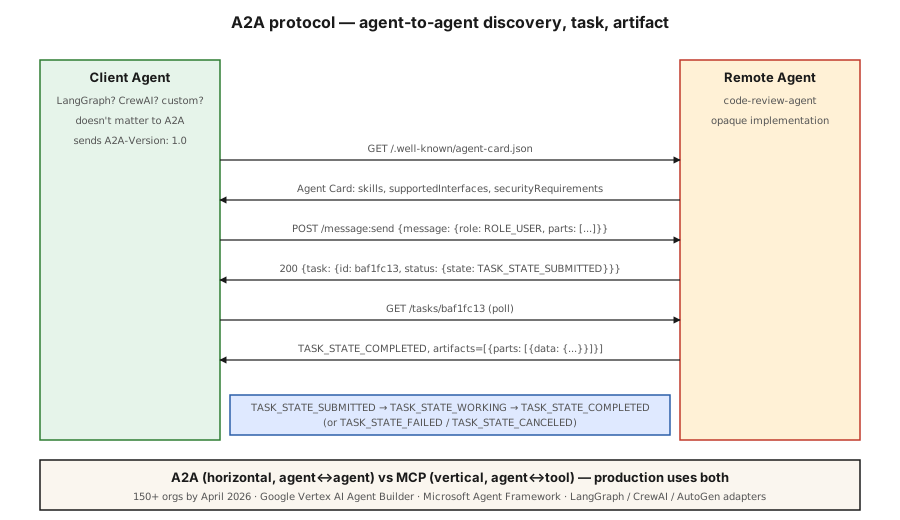
A2A is the universal wire protocol for that call. Standard discovery, standard task model, standard transport, standard artifacts. Like HTTP+REST but for agents as first-class citizens.
Concept
The four elements
Agent Card. A JSON document at /.well-known/agent-card.json describing the agent: name, skills, supportedInterfaces (endpoint URL, protocol binding, protocol version), default input and output media types, and auth requirements (securitySchemes plus securityRequirements). Discovery happens by reading the card.
httpGET /.well-known/agent-card.json HTTP/1.1
Host: agent.example.comjson{
"name": "code-review-agent",
"description": "Reviews Python and TypeScript code.",
"version": "1.0.0",
"supportedInterfaces": [
{
"url": "https:TOK0
"protocolBinding": "HTTP+JSON",
"protocolVersion": "1.0"
}
],
"capabilities": {"streaming": false, "pushNotifications": false},
"securitySchemes": {
"bearer": {"httpAuthSecurityScheme": {"scheme": "Bearer"}}
},
"securityRequirements": [{"schemes": {"bearer": {"list": []}}}],
"defaultInputModes": ["text/plain", "application/json"],
"defaultOutputModes": ["application/json"],
"skills": [
{
"id": "review-python",
"name": "Review Python",
"description": "Reviews Python code.",
"tags": ["code-review", "python"]
},
{
"id": "review-typescript",
"name": "Review TypeScript",
"description": "Reviews TypeScript code.",
"tags": ["code-review", "typescript"]
}
]
}Task. The unit of work. An async, stateful object with a lifecycle: TASK_STATE_SUBMITTED → TASK_STATE_WORKING → TASK_STATE_COMPLETED / TASK_STATE_FAILED / TASK_STATE_CANCELED. A client sends a message, the server creates the task, and the client polls or subscribes for updates.
Artifact. The result type produced by a task. Text, structured JSON, image, video, audio. Artifacts are typed: each part carries one of text, raw, url, or data and can name its mediaType, so different modalities are first-class.
Opaque lifecycle. A2A does not prescribe how the remote agent solves the task. The client sees state transitions and artifacts; the implementation is free to use any framework.
The MCP/A2A split
- MCP (Lesson 13): agent ↔ tool. The agent reads/writes via JSON-RPC to a tool server. Stateless by default.
- A2A: agent ↔ agent. Peer protocol; both sides are agents with their own reasoning.
Production multi-agent systems use both. An A2A peer calls MCP tools on its side. The split keeps the two concerns clean.
Discovery flow
sequenceDiagram
    participant C as Client
    participant S as Agent server
    C->>S: GET /.well-known/agent-card.json
    S-->>C: Agent Card JSON
    C->>S: POST /message:send (returnImmediately)
    S-->>C: task, TASK_STATE_SUBMITTED
    C->>S: GET /tasks/{id}
    S-->>C: TASK_STATE_WORKING
    C->>S: GET /tasks/{id}
    S-->>C: TASK_STATE_COMPLETED, artifacts
These are the HTTP+JSON binding routes, and every request carries A2A-Version: 1.0. By default SendMessage blocks until the task reaches a terminal or interrupted state, so a polling client sets configuration.returnImmediately to get the task back at once.
Or with streaming: POST /message:stream returns Server-Sent Events (a task first, then statusUpdate and artifactUpdate events), and /tasks/{id}:subscribe reattaches to a running task. The stream closes when the task reaches a terminal state; there is no final flag.
Auth
A2A supports three common patterns:
- Bearer token: OAuth2 or opaque (
httpAuthSecuritySchemeoroauth2SecurityScheme). - mTLS: mutual TLS; organizations prove identity to each other (
mtlsSecurityScheme). - API key: a key in a header, query parameter, or cookie (
apiKeySecurityScheme).
Auth is declared in the Agent Card: securitySchemes names each scheme and securityRequirements says which ones a client must satisfy. Clients discover and comply.
150+ organizations by April 2026
Enterprise adoption drove A2A scale. The headline: A2A became the way enterprise agent systems cross trust boundaries. Google Cloud shipped Vertex AI Agent Builder A2A support; Microsoft Agent Framework supports it; most major frameworks (LangGraph, CrewAI, AutoGen) ship A2A adapters.
Where A2A wins
- Cross-organization calls. Agent at company A calls agent at company B. Without A2A, every pair is a bespoke contract.
- Heterogeneous frameworks. LangGraph agent calls CrewAI agent calls custom Python agent. A2A normalizes.
- Typed artifacts. Video result, structured JSON, audio — all first-class.
- Long-running tasks. Opaque lifecycle + polling makes hours-long tasks straightforward.
Where A2A struggles
- Latency-sensitive micro-calls. A2A's lifecycle is async. Sub-millisecond agent-to-agent does not fit; use direct RPC.
- Tight-coupled in-process agents. If both agents run in the same Python process, A2A's HTTP round-trip is overkill.
- Small teams. Spec overhead is real; internal-only agents may not need the formality.
A2A vs ACP, ANP, NLIP
Several related specs emerged in 2024-2026:
- ACP (IBM/Linux Foundation) — predecessor to A2A, narrower scope.
- ANP (Agent Network Protocol) — peer-discovery-heavy, decentralized-first.
- NLIP (Ecma Natural Language Interaction Protocol, standardized December 2025) — natural-language content type.
A2A is the most-adopted peer protocol as of April 2026. See arXiv:2505.02279 (Liu et al., "A Survey of Agent Interoperability Protocols") for the comparison.
Build It
code/main.py implements an A2A-minimal server and client using http.server and JSON, on the 1.0 HTTP+JSON binding. The server:
- exposes
/.well-known/agent-card.json, - accepts
POST /message:send, - manages task state,
- returns artifacts on
GET /tasks/{id}.
The client:
- fetches the Agent Card,
- sends a message with
returnImmediately, - polls until completion,
- reads the artifact.
Run:
python3 code/main.pyThe script starts the server in a background thread, then runs the client against it. You see the complete flow: discovery, submit, poll, artifact.
Use It
outputs/skill-a2a-integrator.md designs an A2A integration: Agent Card contents, task schemas, auth choice, streaming vs polling.
Ship It
Checklist:
- Pin the spec version. A2A is still evolving; every
supportedInterfacesentry declares itsprotocolVersion, and clients sendA2A-Version: 1.0. - Idempotent task creation. Duplicate submissions (network retries) should produce one task. Deduplicate on the client's
messageId. - Artifact schemas. Declare what shapes the agent returns; consumers should validate.
- Rate limits + auth. A2A is public-facing; apply standard web security.
- Dead-letter for failed tasks. Inspect patterns over time for recurring failure types.
Exercises
- Run
code/main.py. Confirm the client discovers the server and receives the correct artifact. - Add a second skill to the server (e.g., "summarize"). Update the Agent Card. Write a client that picks the skill based on task type. A 1.0 request has no skill field, so the server routes on the message parts.
- Implement
POST /message:stream: answer with Server-Sent Events (ataskfirst, thenstatusUpdateevents) and close the stream at a terminal state. What does the client need to do differently? - Read the A2A spec (https://a2a-protocol.org/latest/specification/). Identify three things the spec mandates that this demo does not implement.
- Compare A2A (Agent Card discovery) to MCP (server-side capability listing via
listTools). What is the tradeoff between self-describing agents and capability-probing?
Key Terms
| Term | What people say | What it actually means |
|---|---|---|
| A2A | "Agent-to-agent" | Peer protocol for agents to call other agents across systems. Google 2025. |
| Agent Card | "The agent's business card" | JSON at /.well-known/agent-card.json describing skills, supportedInterfaces, auth. |
| Task | "The unit of work" | Async stateful object with a lifecycle; artifacts produced on completion. |
| Artifact | "The result" | Typed output: text, structured JSON, image, video, audio. First-class media. |
| Opaque lifecycle | "How it's solved is the agent's business" | Client sees state transitions; server is free to choose framework/tools. |
| Discovery | "Finding the agent" | GET /.well-known/agent-card.json returns the card. |
| MCP vs A2A | "Tools vs peers" | MCP: vertical agent ↔ tool. A2A: horizontal agent ↔ agent. |
| ACP / ANP / NLIP | "Sibling protocols" | Adjacent specs; A2A is the most-adopted 2026. |
Further Reading
- A2A specification — the canonical spec
- A2A v1.0.1 release: the tagged
docs/specification.mdandspecification/a2a.protothis lesson follows - Google Developers Blog — A2A announcement — April 2025 launch post
- A2A GitHub repo — reference implementations and SDKs
- Liu et al. — A Survey of Agent Interoperability Protocols — MCP, ACP, A2A, ANP comparison
Diagrams1 figure